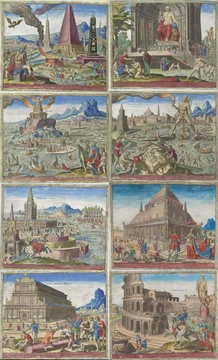
The Acropolis
Ancient citadel atop a rocky outcrop in Athens, Greece.

The Acropolis of Athens is an ancient citadel located on a rocky outcrop above the city of Athens, Greece. It contains the remains of several ancient buildings of great architectural and historical significance, the most famous being the Parthenon. The term 'acropolis' is generic, and there are many other acropoleis in Greece; during ancient times the Acropolis of Athens was also known as Cecropia, after the legendary serpent-man Cecrops.
- location
- Athens, Greece
- surface_area
- about 3 ha (7.4 acres)
- earliest_inhabitation
- 4th millennium BC
- most_famous_structure
- Parthenon
Lore & Background
While the earliest artifacts date to the Middle Neolithic era, there have been documented habitations in Attica from the Early Neolithic period. A Mycenaean megaron palace likely stood on the hill during the late Bronze Age, and a massive Cyclopean circuit wall was built, serving as the main defense until the 5th century. An earthquake before the 13th century BC created a fissure where a well was dug, providing protected drinking water during sieges.
Reader's Guide
The Acropolis of Athens stands as a central symbol of ancient Greek civilization, its buildings representing the height of Classical architecture and the cultural achievements of Athens during its Golden Age. The site's most important structures, including the Parthenon, were coordinated by Pericles in the fifth century BC and constructed by renowned architects and sculptors. Despite this, the remains continue to be a major archaeological and historical resource, with the 'Persian debris' excavated in the 1890s providing one of the richest deposits on the hill. The Acropolis remains a powerful testament to the political, religious, and artistic life of ancient Athens.
Did You Know?
- The word 'Acropolis' comes from Greek 'akron' (highest point) and 'polis' (city).
- During ancient times, the Acropolis was also known as Cecropia, after the legendary serpent-man Cecrops.
- A Mycenaean megaron palace likely stood on the hill, and a Cyclopean circuit wall up to 10 m high was built for defense.
Common Misconceptions (Editorial)
A common misconception is that the Acropolis is a single building; in fact, the Acropolis of Athens is an ancient citadel containing the remains of several ancient structures, with the Parthenon being the most famous among them. Another misconception is that "Acropolis" refers only to this site in Athens, but the term is generic and many other acropoleis exist throughout Greece.
Why It Matters (Editorial)
The Acropolis endures as a symbol of ancient Greek civilization not only for its architectural brilliance, but because it represents humanity's enduring effort to create lasting cultural monuments atop the foundations of earlier societies. Its layered history—from Neolithic habitation to Mycenaean fortifications and Classical temples—reminds us that even the most iconic landmarks are built on centuries of previous human endeavor.
Frequently Asked Questions
What is The Acropolis?
The Acropolis is an ancient citadel perched on a rocky outcrop overlooking the city of Athens, Greece. It holds the ruins of several historically significant structures from antiquity, making it one of the most recognizable archaeological sites in the world.
What is the most famous structure on The Acropolis?
The Parthenon is the landmark that defines the site in the public imagination. It was constructed as a temple dedicated to the goddess Athena and remains the most celebrated ancient building on the outcrop.
How old is The Acropolis?
Evidence indicates people inhabited the rocky outcrop as far back as the 4th millennium BC. That means the site's history stretches back thousands of years before the classical-era structures were raised upon it.
More in World Wonders 1-22
Spotted an error? Know more?
This is a living reference — every entry is fact-audited, and reader corrections feed straight into our audit queue. Suggest an edit · See this site's audit record