Frequently Asked Questions
The most-asked questions about world wonders.
What does the term "World Wonders" actually refer to?
It is an umbrella label for several celebrated lists of extraordinary landmarks, both human-made and natural, that have captured the public imagination across centuries. The most widely recognized are the Seven Wonders of the Ancient World, the New7Wonders of the World (2007), and the Seven Natural Wonders of the World (2007).
What are the Seven Wonders of the Ancient World?
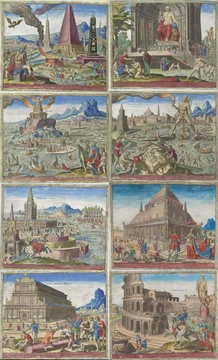
The classical roster includes the Great Pyramid of Giza, the Hanging Gardens of Babylon, the Statue of Zeus at Olympia, the Temple of Artemis at Ephesus, the Mausoleum at Halicarnassus, the Colossus of Rhodes, and the Lighthouse of Alexandria. Only the Great Pyramid still stands today.
Who originally compiled the ancient list?
The earliest known versions surface in Hellenistic Greek travel writing, with Antipater of Sidon and Philo of Byzantium most often credited. The precise original author remains debated, but the list was circulating among Greek-speaking travelers by roughly the 2nd to 1st century BCE.
What is the New7Wonders of the World?
It is a 2007 global ballot organized by the New7Wonders Foundation that chose seven modern landmarks: the Great Wall of China, Petra, Christ the Redeemer, Machu Picchu, Chichén Itzá, the Colosseum, and the Taj Mahal. The Great Pyramid was set aside as a "universal wonder" and did not compete in the vote.
Who was the key figure behind the New7Wonders campaign?
Swiss entrepreneur Bernard Weber founded the New7Wonders Foundation in 2003 to design and run the worldwide ballot. The campaign ultimately gathered more than 100 million votes from roughly 230 countries before the winners were revealed in Lisbon in July 2007.
What are the Seven Natural Wonders of the World?
This parallel 2007 list spotlights non-human landmarks: the Great Barrier Reef, Victoria Falls, the Grand Canyon, Mount Everest, the Amazon River and Rainforest, Ha Long Bay, and the Aurora Borealis. It was likewise selected through a public vote run by the same foundation.
Where should a newcomer start exploring the topic?
Begin with the ancient list to grasp the historical framework, then move to the 2007 New7Wonders and Natural Wonders to see how the concept expanded. From there, the individual sites' construction stories and the controversies surrounding each vote make for rich follow-up reading.
What is the most frequently cited "notable moment" in wonders history?
The 2007 announcement ceremony in Lisbon, broadcast to an estimated 690 million viewers worldwide, is the single most-watched event tied to the topic. Another moment fans often discuss is the 1481 earthquake that finally toppled the Temple of Artemis, the last of the ancient seven to be lost.
Why do so many of the ancient wonders no longer exist?
Earthquakes, fires, and deliberate demolition over roughly two millennia reduced the original seven to a single surviving structure. The Hanging Gardens remain the most enigmatic, as some scholars still question whether they existed beyond legend.
Are there other "wonder" lists beyond the famous ones?
Yes—regional compilations such as the Seven Wonders of the Islamic World, the Seven Wonders of the Medieval World, and various national or thematic lists all exist. These often overlap with the major rosters but add sites like the Alhambra, the Pyramids of Meroë, or the Acropolis of Athens.